


Productivity: How to Get More Done Without Working Longer Hours
Being busy is not the same as being productive. A person can spend an entire day answering messages, attending meetings, updating documents, and completing small tasks without making meaningful progress on their most important work. Likewise, another person may complete fewer tasks but produce better results because they direct their time and attention toward the right priorities.
In a world where digital tools let us work faster, we should not measure productivity by how much activity fills a day. Instead, we should measure it by how effectively that activity produces useful results.
For students, professionals, business owners and people building careers in technology, improving productivity involves more than managing time. It requires understanding how work is organized, what interrupts progress and where effort is being wasted. Technology can help, but only when it solves a real problem.
What Is Productivity?
Productivity is the relationship between the resources used to perform work and the results produced.
Those resources can include time, money, energy, equipment and human effort. The results depend on the nature of the work. While productivity might mean understanding a difficult subject or completing an assignment to the required standard for a student, for a developer, it could mean delivering reliable software. For a business, it might involve serving more customers without a corresponding increase in operating costs. The important point is that productivity considers both effort and output.
Working longer hours does not automatically make someone more productive. Neither does completing more tasks if those tasks contribute little value. A useful way to assess productivity is to ask three questions:
- What result am I trying to achieve?
- What resources am I using to achieve it?
- Could I achieve the same or a better result with less wasted effort?
These questions shift the focus from activity to outcomes. They also explain why we cannot measure productivity in exactly the same way across every role. A customer support team might value the number of emails sent, but that metric does not necessarily reveal whether they resolved customers’ problems. The right measure depends on the result that matters.

Why Being Busy Does Not Always Mean Being Productive
Competing demands fill people’s days and disrupt their focus, causing many to struggle with productivity. Some necessary activities contribute very little to a major objective. Other tasks persist simply because an organization has always run the process that way. Poor planning upfront forces some tasks to become sudden emergencies. Without clear priorities, these activities can consume the time needed for more valuable work.
1. Unclear priorities
When everything appears important, it becomes difficult to decide what deserves attention first. People may spend time responding to whichever request arrives most recently rather than working on tasks that contribute most to their objectives. A better approach is to identify the outcomes that matter most and organize tasks around them. Urgent work still requires attention, but urgency alone should not determine every decision.
2. Frequent interruptions
Messages, notifications, meetings and unexpected requests can fragment attention throughout the day. Switching between tasks also carries a cost. After an interruption, a person may need time to recall where they stopped, review earlier decisions and rebuild their concentration.
The American Psychological Association discusses the costs associated with switching between tasks, including the time and mental effort involved in moving from one activity to another. These costs can vary depending on the task and the person, but frequent switching can make complex work less efficient.
The practical lesson does not require us to disable every notification. Instead, we must manage interruptions according to the demands of our work. Tasks requiring deep concentration often benefit from protected periods of uninterrupted attention. Work that depends on rapid responses may need a different arrangement.

3. Inefficient processes
Sometimes the problem is not the worker’s effort but the way the work is organized. Repeated data entry, unnecessary approvals, duplicated reports and poorly defined responsibilities can all consume resources without improving the final result. Working faster within a bad process may produce only a faster version of the same waste.
Before trying to increase output, examine the process itself. Determine which steps are necessary, which can be simplified and which add no meaningful value.
4. Fatigue and unrealistic workloads
Productivity also depends on human capacity. Insufficient rest, excessive workloads and prolonged periods of concentration can make it harder to maintain attention and produce accurate work. Mistakes may increase, decisions may deteriorate and tasks may take longer than expected.
A productivity system that depends on working at maximum capacity every day is unlikely to remain effective over time. Sustainable productivity requires a realistic understanding of what people can accomplish with the time and resources available.

How to Improve Productivity Without Extending Your Working Hours
Improving productivity does not require changing everything at once. It starts with identifying where time, attention or effort is being lost.
1. Define the outcome before starting
Before beginning a task, establish what successful completion looks like. A vague objective such as working on a report makes it difficult to determine what needs to happen next. A clearer objective identifies the intended result, the requirements, and the point where the team considers the work complete. This makes it easier to distinguish essential work from unnecessary activity. It also reduces the risk of spending too much time polishing details that have little effect on the final outcome.
2. Prioritize by value not convenience
People naturally gravitate towards tasks that are easy to start or quick to complete. These tasks provide an immediate sense of progress, even when more demanding work is more important.
A better method is to evaluate tasks according to their contribution to the desired result, their urgency and the consequences of delaying them. Workers do not need to complete every task immediately. They can schedule some for later, delegate others where appropriate, or remove them entirely.
The objective is not to maintain the longest possible task list. It is to direct limited resources towards the work that matters.

3. Protect attention
Time management is only part of productivity. Attention management matters just as much. Repeated interruptions will stall a person’s progress, even if they reserve two hours for a demanding task.
Consider grouping routine communications into designated periods when the role permits it. Turn off nonessential notifications during concentration-intensive work and establish clear expectations about when colleagues can expect a response.
For work that requires collaboration, agree on communication practices that preserve responsiveness without making constant interruption the default.
These measures are not about avoiding colleagues. They are about making it possible to perform different kinds of work effectively.
4. Break complex work into manageable stages
Large tasks can become difficult to manage when the next action is unclear. Breaking work into defined stages makes progress easier to plan and evaluate. Each stage should have a specific purpose and a clear completion point. This also helps reveal dependencies. Information, approval, or input from another person can easily delay a task. Identifying that dependency early can prevent avoidable delays.
Progress becomes easier to manage when people know what needs to happen next rather than repeatedly deciding where to begin.
5. Review results not just completed tasks
A completed task is not always a successful outcome. A report may be submitted but contain errors. A marketing campaign may generate engagement without producing sales. A software feature may be delivered but fail to solve the user’s problem. Review productivity using measures that reflect the purpose of the work.
The goal is to understand whether the work is producing value, not simply whether activity is taking place.
How Technology Can Improve Productivity
Technology can reduce repetitive work, improve coordination and make information easier to access. However, their value depends on how well it addresses the problem and the tools employed.
- Task and Project Management Tools: Task management software can help people organize responsibilities, set deadlines and track progress. Project management platforms can also make dependencies and shared responsibilities more visible.
These tools are most useful when they improve coordination or reduce uncertainty. They lose their usefulness when people spend more time maintaining dashboards than completing the work those dashboards should support.
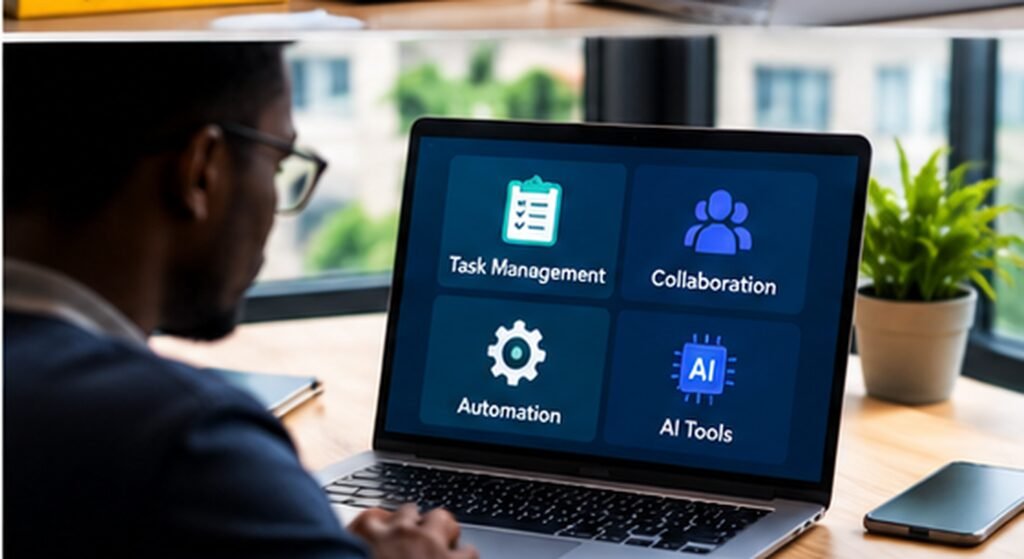
- Collaboration and Communication Tools: Digital communication platforms allow teams to share files, coordinate activities and work across different locations. Their effectiveness depends on communication practices as well as the software itself. It is advisable to use the communication method that suits the task. Some matters require a live discussion. Others can be handled through a written update that colleagues can review when they are available.
- Automation: Automation is useful for repetitive, rule-based activities that consume time without requiring substantial human judgement. Examples include transferring information between systems, generating routine reports, sending standard notifications and processing recurring administrative tasks.
Before automating a process, establish how much time it consumes, how frequently it occurs and what errors or delays it creates. This provides a basis for evaluating whether automation is worth the effort and cost. Automation also requires maintenance. This should be included when assessing the benefits.
- Artificial Intelligence: AI tools can support research, summarization, drafting, information classification and other knowledge-intensive tasks. They can reduce the time required to produce a first draft or organize large amounts of information. However, faster generation does not guarantee accurate or useful output.
AI-generated information may contain errors, omit important context or require substantial editing. Sensitive information also needs appropriate handling, especially when external services are involved.
The relevant metric measures the total effort required to produce a reliable result. If a tool saves ten minutes during drafting but requires extensive checking and correction, it may limit its overall productivity benefit. Organizations should therefore introduce AI where it improves a defined workflow, while ensuring humans review tasks where accuracy matters.
Samic Tech Hub has explored the wider role of technology in its article on “Cloud Computing.” The same principle applies to productivity tools: technology is valuable when it helps people achieve useful outcomes more effectively.

Productivity in the Nigerian Working Environment
Productivity is shaped by individual habits, organizational systems and the conditions in which people work.
In Nigeria, some workers and businesses must account for unreliable electricity, inconsistent internet connectivity, transport demands and differences in access to suitable equipment or working environments. The effects vary by location, occupation and organization, so these challenges should not be treated as universal.
They nevertheless illustrate an important point: productivity cannot always be improved through personal discipline alone. A person may plan carefully but still lose time to an infrastructure problem.
Practical improvements should account for these constraints.
Depending on the situation, organizations may benefit from backup power arrangements, reliable connectivity, better equipment planning or processes that allow work to continue during disruptions. Individuals may need to organize tasks around available resources while avoiding assumptions that every disruption can be prevented through better time management.
A suitable working environment —a resounding workspace like Samic’s co-workspace— can also support productivity by providing the infrastructure and conditions needed to concentrate and collaborate.
The most effective productivity strategies are adapted to actual working conditions.
Tech Takeaway
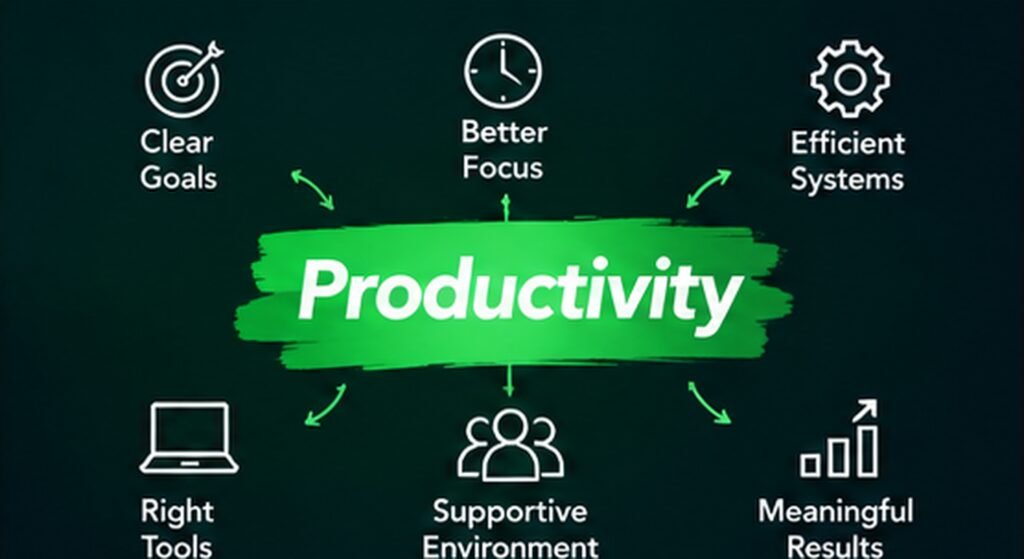
Productivity is not about filling every hour with activity. It is about producing meaningful results with the time, attention and resources available.
Better priorities, fewer unnecessary interruptions, simpler workflows and appropriate technology can all help. But their effectiveness depends on the problem being addressed and the conditions in which the work takes place.
Before adding another tool or extending your working hours, examine the process. Identify what matters, determine what is slowing progress and remove avoidable waste.
The aim is not to do more for the sake of doing more. It is to make the work count.
Samic Tech Hub