

HOW NIGERIAN BUSINESSES CAN TURN ONLINE ATTENTION INTO CUSTOMERS
Getting people to notice your business online is no longer enough. The real challenge is turning that attention into enquiries, customers and repeat business. Successful brands win because they build integrated marketing engines where search visibility, paid media, data analytics and customer retention systems work together. This coordinated approach systematically lowers the cost of customer acquisition (CPA) and maximizes customer lifetime value (LTV).
To build a digital footprint that scales, businesses must design assets that appeal to both automated search engine crawlers and human buyers. This architectural blueprint outlines how to build an integrated digital marketing ecosystem designed to earn search engine indexation, capture market attention and turn casual web browsers into loyal customers.
The opportunity is significant. DataReportal’s Digital 2026: Nigeria report estimated 109 million internet users at the end of 2025, while the number of social media user identities reached 47.8 million.
WHAT IS DIGITAL MARKETING?
Digital Marketing is the process of using digital channels to attract the right audience, earn their attention, build confidence and move them towards an action. It is not simply posting on social media, boosting an advert or creating a website. Digital marketing is marketing carried out through internet-connected platforms and digital technologies.
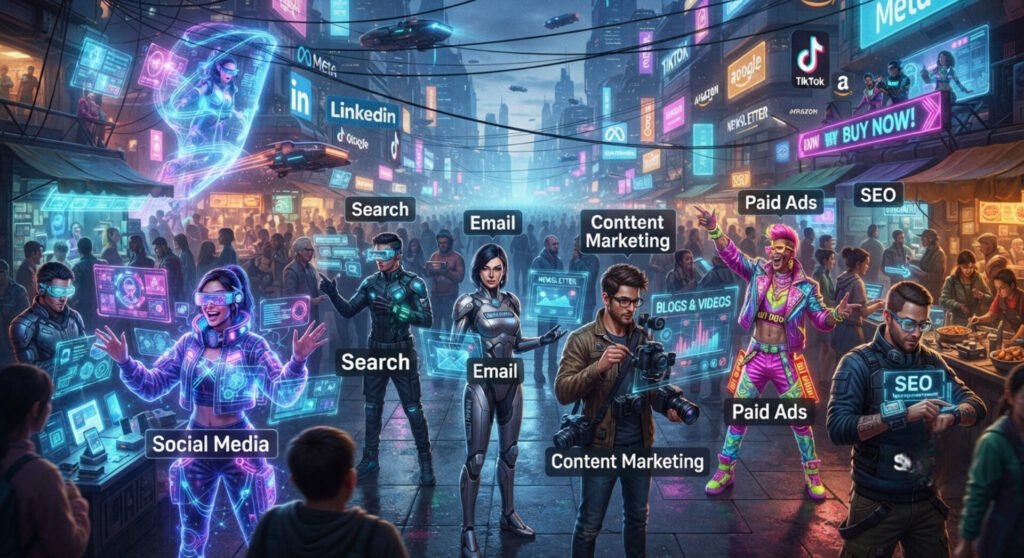
It includes activities such as: search engine optimisation (SEO), search advertising, social media marketing, content marketing, email marketing, online advertising, influencer marketing, video marketing, conversion optimisation, marketing analytics and marketing automation. These channels perform different jobs.
SEO can help a business appear when someone is actively searching for a solution. Social media can introduce a brand to people who were not looking for it. Email can bring existing customers back. Paid advertising can put a specific offer in front of a carefully selected audience.
A strong digital marketing strategy connects these activities instead of treating them as separate tricks.

WHY DIGITAL MARKETING MATTERS IN NIGERIA
Nigeria has a large and increasingly connected digital audience but the numbers also reveal an important limitation.
DataReportal recorded 109 million internet users at the end of 2025, equivalent to 45.5% internet penetration. That means a substantial portion of the population was still offline.
This creates an interesting situation for businesses. A company cannot assume that “everyone is online.” At the same time, ignoring digital channels means ignoring a very large potential market. The better approach is to understand where your particular customers spend time and how they make purchasing decisions.
A university student looking for a laptop may discover products through social media, compare prices through search and complete the purchase through a website or messaging platform. A corporate buyer may behave differently, relying heavily on search, referrals, professional networks and detailed product information.
Digital marketing works best when the business understands those differences. Digital Marketing Is Not the Same as Social Media Marketing. This confusion causes many businesses to build an incomplete digital strategy.
Social media marketing is one part of digital marketing.
A business that posts every day on Instagram but has no searchable website, no customer database, no email strategy and no way to measure conversions may have social media activity without having a strong digital marketing system.
Consider two businesses –Business A and B.
Business A posts product photos regularly but directs customers to “DM for price.”
Business B publishes useful product information, appears in relevant Google searches, uses social media to demonstrate its products, maintains a website with clear pricing and gives customers a direct route to purchase or enquire.
Both businesses are using social media but Business B has built a broader digital customer journey. That distinction matters.
CONTENT CREATION
Content creation is particularly powerful when combined with SEO. Digital marketing through content creation can take many forms:

1. SOCIAL MEDIA POSTS: Build Attention and Conversation
Social media provides something search engines cannot always provide easily –ongoing creative attention.
A restaurant can post a new dish, a typical fashion brand can show how a product looks when worn, even a technology company can explain a new feature through a short video. These posts allow people to see the business repeatedly rather than encountering it only when they are ready to buy.
Nigeria’s social media audience is substantial. DataReportal estimated 47.8 million social media user identities in the country in October 2025, although it cautions that these figures do not necessarily represent unique individuals. That audience is valuable but follower count should not become the main objective. A business with 5,000 relevant followers who regularly enquire or purchase can have a stronger marketing system than one with 100,000 passive followers.
Reach is useful. Relevance is better. Conversion is the goal.
2. BLOGS & TUTORIALS:
A tutorial as a unique content concept must be visually and simply comprehensible. Modern audiences crave a blend of entertainment, efficiency and high production value. The most successful approaches focus on engaging formats like micro-learning guides, interactive story-driven lessons and high-impact structural hooks.
A useful article can attract someone through search, educate them and introduce them to the company’s services without beginning with a hard sales pitch.
The best content doesn’t exist simply to fill a publishing calendar. It answers a question, solves a problem or helps someone make a decision.
3. INFOGRAPHICS:
Infographics are a powerful form of visual content but they are undergoing a massive evolution. While standard infographics rely on static images, the modern way to use infographics as a content is through dynamic visual models. Instead of just presenting fixed numbers, interactive elements allow users to explore variables, see mathematical relationships in real time and gain personalized insights.
4. CUSTOMER STORIES:
In digital marketing, customer stories act as a captivating bridge between product features and emotional, real-world proof. Modern consumers and B2B buyers are highly skeptical of corporate marketing copy and polished sales pitches. Customer stories are uniquely powerful because they leverage core psychological and structural advantages. Buyers trust the word of their peers far more than a brand’s self-advertisement. Seeing a real person or company put their name, face and reputation behind your product builds immediate credibility.
THE CORE CHANNELS OF DIGITAL MARKETING
1. S.E.O OPTIMISATION: Get Found When People Are Searching
Search engine optimisation helps a website become more discoverable for relevant searches. The opportunity lies in understanding what potential customers actually search for. SEO helps businesses appear when potential customers actively search for something. For a Nigerian business, this could mean targeting searches such as:
- web development classes in Lagos
- affordable office space in Lagos
- digital marketing agency in Nigeria
- cybersecurity training in Nigeria
- catering services in Abuja
The goal is not to repeat these phrases unnaturally across a website but to create genuinely useful pages that satisfy the searcher’s need.
2. PAID ADVERTISING: BUY TARGETED ATTENTION
Paid advertising allows businesses to place targeted messages in front of specific audiences. Google Ads can capture people already searching for a product or service, while platforms such as Facebook, Instagram and TikTok can help businesses reach audiences based on interests, demographics and behaviour. Paid advertising can produce faster visibility than SEO but it requires careful targeting and measurement. Paying for traffic does not automatically make the traffic valuable. Organic marketing takes time but paying for traffic doesn’t fix a weak offer.
Effective paid marketing often times requires more than creating an advert. The entire journey matters. If one part fails, the advertising budget becomes less efficient.
3. EMAIL MARKETING: DON’T LOSE CUSTOMERS AFTER THE FIRST SALE
Social media platforms control access to their audiences. An algorithm can change. A platform can restrict reach. Advertising costs can increase.
An email list gives a business a direct communication channel with people who have voluntarily provided their contact information. An online store might use email to announce new products. A training company could notify past learners about a new course. Email becomes especially valuable when the business has something useful to say. Sending constant promotional messages can make people unsubscribe. Useful communication creates a reason to stay.
4. ANALYTICS: STOP GUESSING WHAT WORKS
One of the biggest advantages of digital marketing is measurability. Measurability help separate activity from results. For example, suppose one social media post receives 50,000 views but produces two enquiries; another receives 8,000 views and produces 60 enquiries. Without analytics, it is easy to celebrate the wrong metric and channel resources biasedly.
HOW AI IS CHANGING DIGITAL MARKETING
Artificial intelligence is changing how businesses research audiences, create content, analyse campaigns and automate repetitive marketing tasks. A marketer can use AI to generate content ideas, summarise customer feedback, analyse large amounts of information or produce initial drafts. But AI does not remove the need for marketing judgement. A generic AI-generated article about “the importance of digital marketing” is unlikely to give a Nigerian business a meaningful competitive advantage. That’s why it is crucial to carry out an editorial on AI generated contents.
Search engines are increasingly focused on useful and original content rather than content produced simply at scale. Bing’s current guidance also warns against excessive repetition, keyword stuffing and low-value automatically generated content.
THE GOAL OF DIGITAL MARKETING
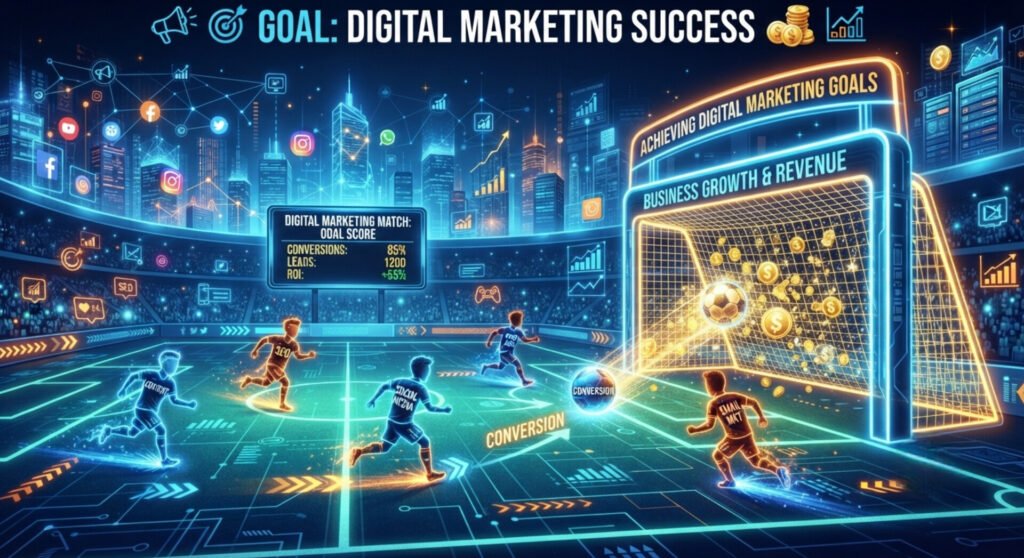
The goal of digital marketing is to create awareness that turns to potential sales. The customer first encounters the business through social media, search, video, advertising or referrals. The customer moves to investigating by visiting the website, comparing options across multiple categories, reading reviews or asking questions.
These may result in the customer taking the desired action that could be a purchase, booking, enquiry, registration or phone call.
It shouldn’t end there as you should optimize for retention and giving the customer a reason to return. This might involve excellent service, useful communication, loyalty programs or personalized offers. And a satisfied customer will most likely recommend the business to someone else which in turn creates another potential entry point into the funnel.
The important point is that marketing doesn’t stop when someone clicks an advert.
TECH TAKEAWAY
Digital marketing is not about being everywhere. It is about being useful where your customers are looking, giving them enough confidence to take action and measuring what happens next.
For Nigerian businesses competing in an increasingly connected market, digital marketing is no longer simply an advertising option. It is becoming part of how customers discover, evaluate and interact with businesses.
The right place to start is by learning!
Explore Samic Tech Hub and discover practical tech training designed to help you build skills for the future of work.
Start learning. Build your skills. Create your career opportunities.
Samic Tech Hub