

Nigeria’s fintech industry has already changed how millions of people send money, receive payments, save, invest and access financial services. The next question is not whether artificial intelligence will enter fintech; it already has. The more useful question is what happens when AI systems move beyond identifying problems or answering questions. And begin helping financial institutions investigate situations, coordinate actions and respond faster. These matters in Nigeria because the financial system is becoming increasingly digital while fraud and cyber threats are also becoming more sophisticated.
The Nigeria Fintech Week 2026, held across Lagos, Port Harcourt and Abuja on September 22–23, puts payments, infrastructure, regulation, lending, cross-border finance, banking transformation and financial inclusion among its major discussion areas. NFW 2026 Agenda.
Agentic AI sits naturally inside that conversation because financial services are full of processes that involve monitoring, decision-making, verification and action.
AI in Nigerian Fintech Is Already Doing Real Work
AI is already being used for fraud detection, transaction monitoring, identity verification, customer support and risk management.
A recent example is OPay. The company said its internally developed risk-control system combines artificial intelligence, big-data analysis and real-time transaction monitoring. According to OPay, the system uses more than 5,000 monitoring and blocking rules and more than 10,000 risk-feature profiles to assess transaction behaviour. The important point is not simply that AI can detect suspicious transactions. It is that financial systems are beginning to connect detection with intervention. If a system identifies suspicious behaviour within milliseconds and can trigger a predefined control such as blocking a transaction or escalating an account for review, it is already moving closer to the operational model that makes agentic AI interesting.
That does not mean OPay’s system should automatically be described as a fully autonomous AI-agent system. The company has described its technology as including AI and intelligent-agent technology but the broader lesson is about the direction of financial technology rather than assigning a specific technical label to one company’s architecture.
Why Fraud Detection Needs to Become More Contextual
Nigeria’s fraud problem shows why context matters. The CBN — Payments System Vision 2028 sets security and trust among the principles guiding Nigeria’s payments system through 2028. Data from the CBN’s Payments System Vision 2028 document shows that banks and customers lost ₦134.48 billion to fraud between 2020 and 2025, while attempted fraud during the period amounted to ₦187.79 billion. The annual figures also show why a single static fraud rule is not enough. Losses rose from ₦11.61 billion in 2020 to ₦17.67 billion in 2023 before reaching ₦52.26 billion in 2024. Losses then fell to ₦25.85 billion in 2025.
The 2024 figure was unusually high and should not be interpreted as a simple uninterrupted trend. The CBN data includes a major internal-fraud case that materially affected that year’s total. This is where contextual systems become useful.
A ₦500,000 transfer is not automatically fraudulent. But the same transfer could become significantly more concerning when combined with a new device, unusual login behaviour, rapid changes to account information and a recipient with a suspicious history. An AI agent could potentially bring those separate signals together rather than treating every alert as an isolated event.
AI Could Help Fight AI-Enhanced Fraud
There is another problem emerging at the same time: fraudsters can use AI too. Deloitte Nigeria — Cybersecurity Outlook 2026identifies AI-powered scams, identity fraud, deepfakes and increasingly convincing phishing as part of Nigeria’s evolving cybersecurity environment. The report also describes Agentic AI as capable of continuously monitoring environments, identifying unusual behaviour and responding quickly. At the same time, it warns that similar capabilities can be abused by attackers. That creates an unusual situation. Financial institutions are not simply using AI against traditional fraudsters. They may increasingly be using AI against criminals who themselves have access to AI-assisted tools. A fraudster can generate more convincing messages, automate scouting and imitate trusted communication more effectively. A defensive AI system therefore needs to examine behaviour and context rather than relying only on whether a message looks legitimate.
The CBN pushing financial institutions toward faster detection regulation is another reason agentic systems could become relevant. In January 2026, the CBN — reforms and initiatives announced a 30-minute fraud response rule, directing banks to reduce fraud response times to less than 30 minutes. This require automated monitoring systems capable of real-time detection, analysis and reporting of suspicious financial activities across banks, mobile money operators, international money transfer operators and other regulated institutions.

The CBN’s March 2026 guidance on instant payments also requires financial institutions to deploy real-time enterprise fraud monitoring and strengthen identity verification. The measures include additional controls around newly activated devices and multi-factor authentication for changing instant-payment preferences. These requirements do not mean the CBN is requiring banks to deploy AI agents. But they create an environment where faster automated detection, investigation and response become increasingly important.
Fintech Infrastructure Is Becoming Part of the AI Question
There is also a less obvious issue. AI agents do not operate in isolation. They depend on the infrastructure around them. If payment APIs fail, identity services are unavailable or a third-party provider becomes overloaded, an AI agent cannot simply reason its way around the problem.
A recent Reuters report on the Dangote Petroleum Refinery IPO illustrated this infrastructure problem. The large public offering placed significant demand on Nigerian digital investment platforms with some platforms experiencing outages as traffic surged.
The lesson for AI is straightforward: more intelligent software does not automatically create more resilient infrastructure. The underlying payment rails, APIs, identity systems, cloud services and third-party providers still matter.

Where Should the Agent’s Authority Stop?
The most important question may not be what an AI agent can do. It may be what an institution allows it to do. A system that can investigate a suspicious transaction is one thing. A system that can freeze accounts, move money, change customer information and close cases without meaningful oversight is something else entirely.
Recently, Nigerian fintech Bujeti’s AI workforce, called BRAIN, is designed to handle finance operations while keeping sensitive financial actions under human control. The company says its AI agents can prepare actions but cannot independently move money. Authorized users must review and approve financial actions and the system maintains records that help explain what happened. This shows why those boundaries matter. An agent might be allowed to:
- Investigate transaction patterns.
- Gather information from approved systems.
- Create fraud cases.
- Recommend an action.
- Trigger predefined low-risk workflows.
- Escalate high-risk cases.
- Produce compliance reports.
- Monitor systems for unusual behaviour.
Actions with significant financial or customer consequences could require human approval. Every important action should also produce an audit trail showing what the system observed, what rules or information influenced the decision and what action followed.
Deloitte Nigeria — Cybersecurity Outlook 2026 similarly emphasises combining AI capability with human judgment rather than treating AI as a complete replacement for security professionals.
What Nigerian Fintechs Could Realistically Use Agents For
The most practical early applications will be narrow rather than fully autonomous. An AI agent could help with:
- Fraud investigation: Connect transaction, device, identity and behavioural signals into one investigation.
- Customer-service investigation: Check the status of failed or disputed transactions and prepare the appropriate next step.
- Compliance operations: Gather information and prepare reports for compliance teams.
- Risk monitoring: Continuously monitor predefined signals and escalate unusual activity.
- Document and application checks: Identify missing information before a human officer reviews a case.
- Incident response: Monitor selected systems and coordinate predefined responses when a security event occurs.
These applications are less about replacing financial professionals and more about optimizing the amount of manual coordination they have to perform.
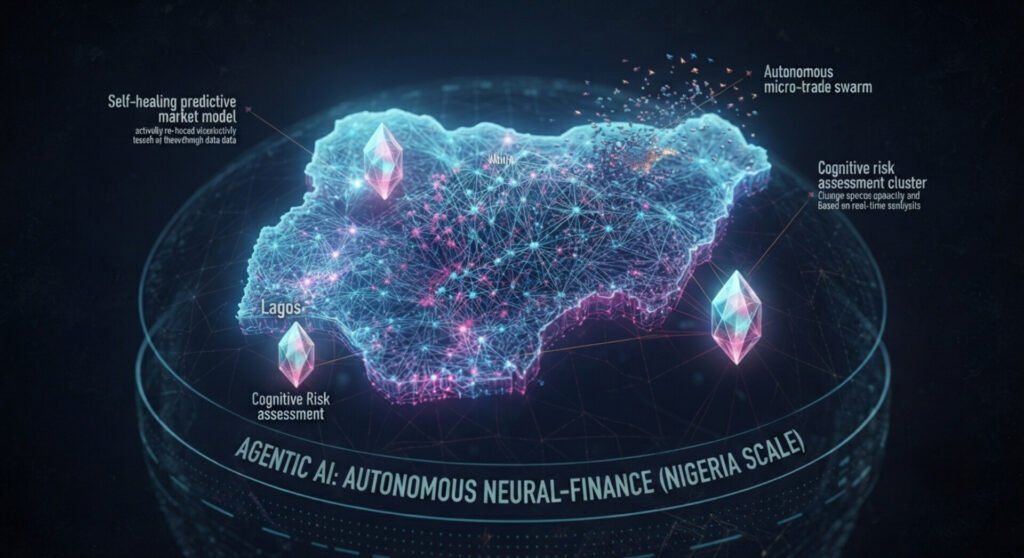
Direction of Nigeria’s Tech Industry
Nigeria’s fintech industry is dealing simultaneously with payments growth, regulation, cybersecurity, digital identity, infrastructure and financial inclusion. That makes agentic AI particularly relevant because agents are designed around processes rather than isolated outputs. But there is a difference between having an AI agent and having a financial system that is ready for one.
A fintech with poor data quality, weak identity controls, unreliable APIs or unclear internal processes will not automatically become safer by adding an AI agent. In some cases, it could simply automate a bad process faster. The foundations have to come first: reliable data, clear permissions, strong security controls, human escalation and well-defined workflows.
Could AI Agents Change Nigerian Fintech?
Yes! The potential is already established but probably not in the way the hype sometimes suggests. It may be thousands of smaller systems quietly handling pieces of financial work that currently require people to monitor, investigate, compare, verify and coordinate manually. There is also the issue of trust.
Visa’s 2026 study of Nigerian consumers found that 89% believed AI would play an important role in future fraud protection but only 34% said they currently trusted AI agents to complete checkout. While, consumers may be increasingly comfortable with AI helping protect financial activity, they remain more cautious about allowing AI to act directly on their behalf. For fintech companies, this distinction could shape how quickly customers accept agent-led financial services.
What Fintechs Should Do Now
Nigerian fintechs should not wait for AI-powered fraud to become a larger problem before strengthening their defenses. Review your fraud controls, identity systems and incident-response processes now. Test how your organization would respond to AI-assisted phishing, deepfakes, account takeover and coordinated transaction fraud. Where AI agents are introduced, give them clearly defined permissions, continuous monitoring and human escalation for high-risk actions. Cybersecurity cannot be treated as a feature added after the financial product is built. It has to be part of the product from the start.
If your career interest is piqued at reviewing cybersecurity posture for fintechs, startups or businesses, Samic Tech Hub is a click below.
Talk to Samic Tech Hub about Cybersecurity Tutorial Course .
Tech Takeaway
Fraud detection could become more relevant. Customer support could become more action-oriented. Compliance teams could automate more investigation and reporting work. Security teams could respond to certain events faster. But the technology will only be as reliable as the systems surrounding it.
For Nigerian fintech, the question should not just be “Can AI agents do this?” Rather, “which financial decisions can safely be delegated to software and which should remain under human control?”
That is likely to be one of the more important technology questions as Nigeria’s digital financial system continues to mature.
Samic Tech Hub