


AGENTIC AI REVOLUTION
Artificial intelligence is moving beyond simply answering questions. AI is increasingly being designed to plan, make decisions and take actions to achieve a goal.
But what exactly is Agentic AI, and why is everyone talking about it?
WHAT IS AGENTIC AI?
Think of it as a type of AI Singularity. Agentic AI is a type of artificial intelligence that can work toward a goal with a level of independence. Regular AI usually waits for prompts to be given to it. You ask a question; it gives you an answer.
Agentic AI can go a step further. You give it a goal, and it can decide what steps may be needed to reach that goal. It highlights continuity. For example, imagine you tell an AI: “Help me organize a birthday party.” A normal AI might give you a list of things you need to do but an agentic AI could potentially break the job into tasks such as:
- Create a guest list
- Suggest a budget
- Find suitable venues
- Prepare a shopping list
- Create invitations
- Organise a schedule
The important difference is that Agentic AI focuses on completing a goal not just answering a question.

HOW DOES AGENTIC AI WORK?
Agentic AI can be easier to understand if you think of it as a digital assistant. You give it a goal. It thinks about what needs to happen, takes an action and checks the result. Then it decides what to do next. A simple version looks like this:
Goal → Plan → Act → Check → Adjust.
For example, if an AI agent is asked to research a topic, it may:
- Understand the question.
- Search for information.
- Compare what it finds.
- Organise the information.
- Produce a result.
The exact process depends on the AI system and the tools it has access to.
AGENTIC AI VS GENERATIVE AI
You may already be familiar with Generative AI tools such as ChatGPT and other AI assistants that can generate text, images, code and other content. So, what makes Agentic AI different? To understand Agentic AI, look at how it compares to the Generative AI we use today:
-
Generative AI (The Assistant):
You give it a detailed prompt, and it gives you words, code or images. If you want a multi-step task done, you have to prompt it over and over. It acts like an incredibly fast copywriter. -
Agentic AI (The Worker):
You give it a high-level goal. It breaks that goal into smaller steps, figures out what tools to use and works until the job is done. It acts like an autonomous employee.
| Generative AI | Agentic AI |
| Creates new content and briefs. | Executes multiple and dynamic plans and goals. |
| Depends on human prompts to produce an output per enquiry. | Receives a high-level input goal and accomplishes it to the most probable end. |
| Limited to generating responses and summaries. | Can use external tools, browse apps and buy goods. |
| Responds based on instant prompts and repeated training. | Adapts plans and prompts as crucial and as necessary. |
| Expert-level research assistant. | Highly autonomous and self-reliant. |
THE AGENTIC AI EVOLUTION: WHY THE NEXT ERA OF TECH IS ABOUT ACTIONS NOT WORDS
Agentic AI is the defining technology of the late 2020s, shifting artificial intelligence from a passive chatbot that writes text to an autonomous workforce that executes real-world actions.
While the first wave of AI required you to manually prompt a model for every single response, AI Agents are designed to think, plan, use software tools and accomplish complex goals completely on their own.
Whether you are a business executive looking to scale operations, a developer building the future, or an ordinary tech enthusiast trying to understand how this changes daily life, here is your definitive guide to the agentic shift.
INSIDE THE TECH STACK: TOP AI AGENT FRAMEWORKS (OUR APPLIED EVALUATION)
If you want to build an AI agent today, you don’t start from scratch. Development teams utilize specialized open-source code libraries and SDKs to manage agent logic, tools, and memory. Looking at these tools through an operational lens, here is how the market leaders compare right now:
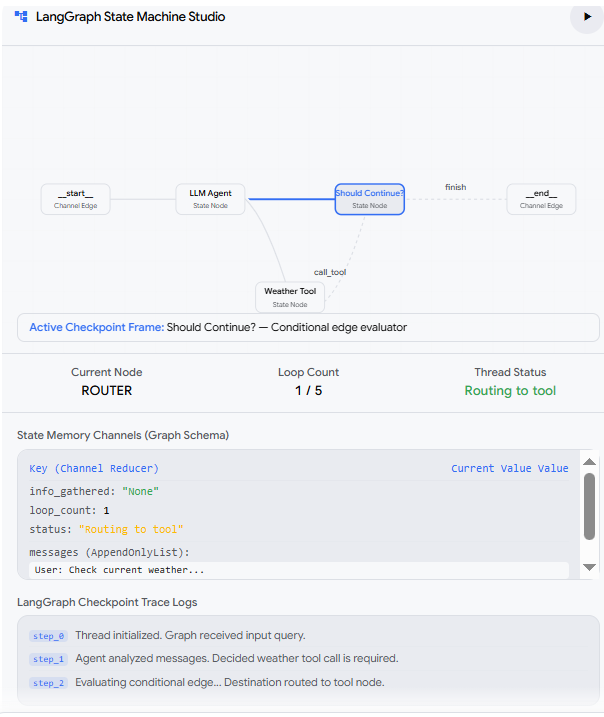
The interactive agent simulator above mirrors LangGraph’s cyclic state machine design. While basic frameworks rely on linear pipelines, LangGraph maps operations as Nodes (actions or model processing steps) and Edges (conditional routing paths), making it the enterprise standard for deterministic AI workflows.
-
LangGraph (The Production King):
Created by the LangChain ecosystem, it treats agents as graphs consisting of nodes and connections.
Our analytical take: It requires significant senior developer hours to deploy initially, but it offers the highest level of deterministic control required for corporate compliance and predictable workflows.
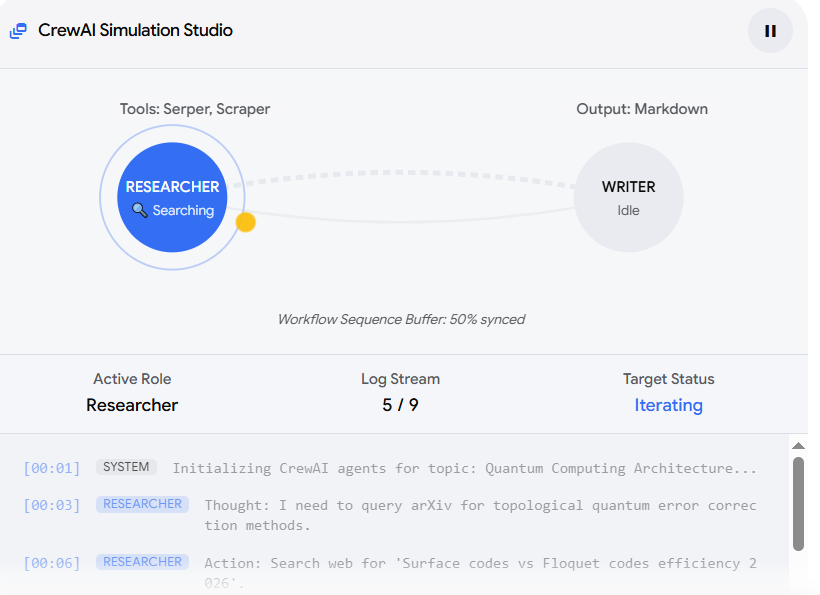
The interactive agent simulator above brings this multi-agent workflow to life. It lets you trigger the live code execution loop and monitor the underlying process states exactly as they would register inside an operational workspace.
-
CrewAI (The Role-Based Orchestra):
The easiest framework for setting up a literal crew of AIs. You can spin up an agent named “Researcher,” another named “Writer,” give them distinct tasks, and watch them collaborate.
Our analytical take: This is the most intuitive tool for business automation and marketing teams. The speed to deployment is incredibly fast, making it ideal for non-technical product managers to test out automated content workflows.
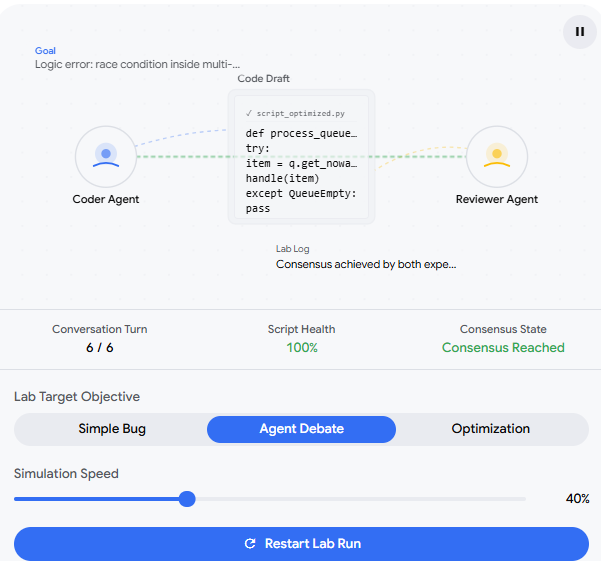
The interactive simulation above models Microsoft AutoGen’s Conversation Lab architecture. Unlike the sequential pipeline of CrewAI, AutoGen relies on a conversational loop where independent agents pass messages back and forth dynamically until a termination condition (consensus) is met.
-
Microsoft Agent Framework / AutoGen (The Conversation Lab):
Microsoft’s engine allows multiple independent agents to chat, debate and solve coding or engineering problems together until they reach a consensus.
Our analytical take: Highly capable for data analytics and complex engineering labs, though it requires strict computational guardrails to avoid runaway infrastructure costs.
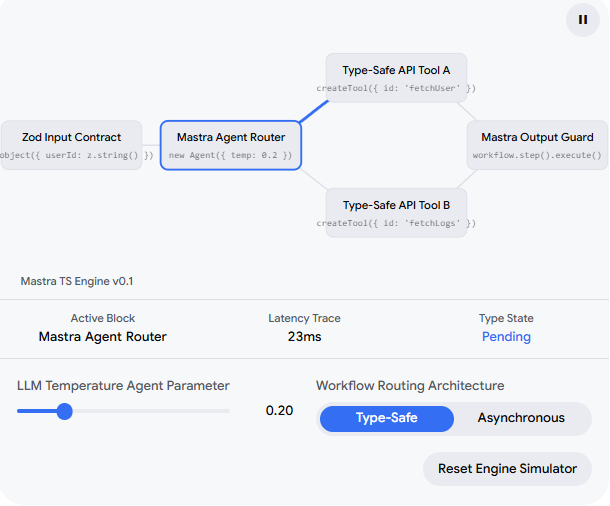
The interactive agent simulator above mirrors Mastra, the premier open-source TypeScript framework designed natively for Node.js, Next.js, and edge runtimes. By avoiding heavy Python abstractions, it lets web developers build production-grade agentic workflows directly inside their existing JavaScript ecosystem.
-
Mastra (The TypeScript Option):
While most AI tools are written in Python, Mastra caters to the millions of web developers building native JavaScript and TypeScript web applications.
Our analytical take: A strategic choice for enterprise teams whose entire digital infrastructure is already built on JavaScript, saving thousands in cross-platform migration friction.
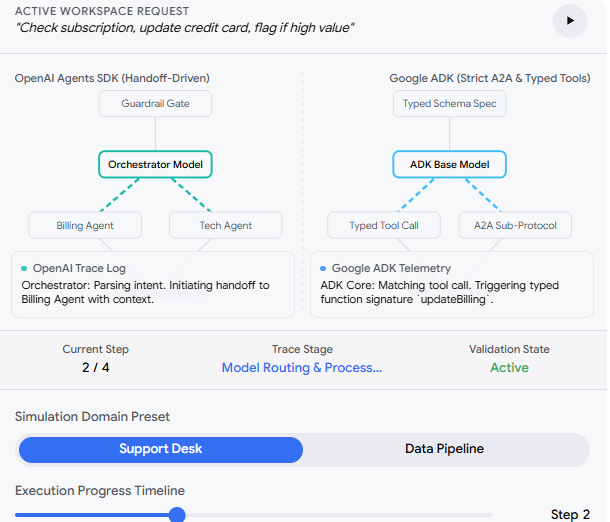
The interactive simulation above analyzes the execution behaviors of OpenAI Agents SDK and Google’s Agent Development Kit (ADK). These engines bypass the heavy, abstract middle-layers of third-party frameworks to interface directly with the model providers’ core infrastructures.
-
Model-Native SDKs (OpenAI Agents & Google ADK):
Released natively by the creators of the giant LLMs.
Our analytical take: The lowest-overhead option for teams looking to test vendor-locked agent architectures without relying on unstable third-party middleware packages.
WHAT CAN AGENTIC AI BE USED FOR?
REAL-WORLD APPLICATIONS
For Software Developers & Students:
AI agents can assist developers with tasks such as writing code, finding errors and testing software.
-
Software Engineers:
Instead of just writing code snippets, agents can ingest a full GitHub repository, read a bug ticket, write a patch, run tests to ensure nothing else broke and submit a pull request. -
Research:
Students can feed an agent an entire syllabus. The agent will track deadlines, cross-reference textbook chapters, auto-generate daily quizzes and adjust the study plan based on incorrect answers.
For Business Executives & Managers:
Companies could use AI agents to help with repetitive work such as organising information, handling routine requests or managing parts of a workflow.
-
End-to-End Operations: Imagine an agent that monitors your inventory. When stock drops, it automatically drafts a purchase order, messages the vendor, updates the accounting software and alerts the warehouse—no human intervention required.
Early enterprise adopters implementing this tool mesh have reported up to a 40% reduction in manual data-entry overhead within the first quarter.-
Case Study Insight:
-
Hyper-Personalized Customer Success:
Agents can pull an unhappy customer’s purchase history, check shipping delays on external carrier sites, issue a refund via payment gateways and email a custom apology code.Customer Service:
AI agents could potentially handle common customer questions and help solve simple problems without requiring a human to handle every step.For Everyday Tech Enthusiasts & Ordinary Folks:
Turns AI into a personal concierge that manages schedules, books travel and files complaints for you.
-
The Life Admin Manager:
Tired of sitting on hold with airlines or subscription services? In the near future, you will tell your agent, “Cancel my premium subscription and dispute that double-charge.” The agent will navigate the portals, chat with support bots, and notify you when it’s resolved. -
Personal Productivity:
AI assistant can help organise your tasks, manage information and keep track of your priorities.

FINAL THOUGHTS
Artificial intelligence is changing quickly. We’ve gone from AI that could answer simple questions to systems that can generate writing, images, videos and code. Now we’re moving toward AI that can plan and take action.
And as that technology develops, understanding it could become just as important as knowing how to use it.
TECH TAKEAWAY
Generative AI helps create. Agentic AI helps pursue a goal. The technology is still evolving, but one thing is clear: AI isn’t just getting smarter. It’s becoming more capable of taking action. The question is no longer simply, “What can AI do?”
It’s: “What could you do with it?”
Samic Tech Hub